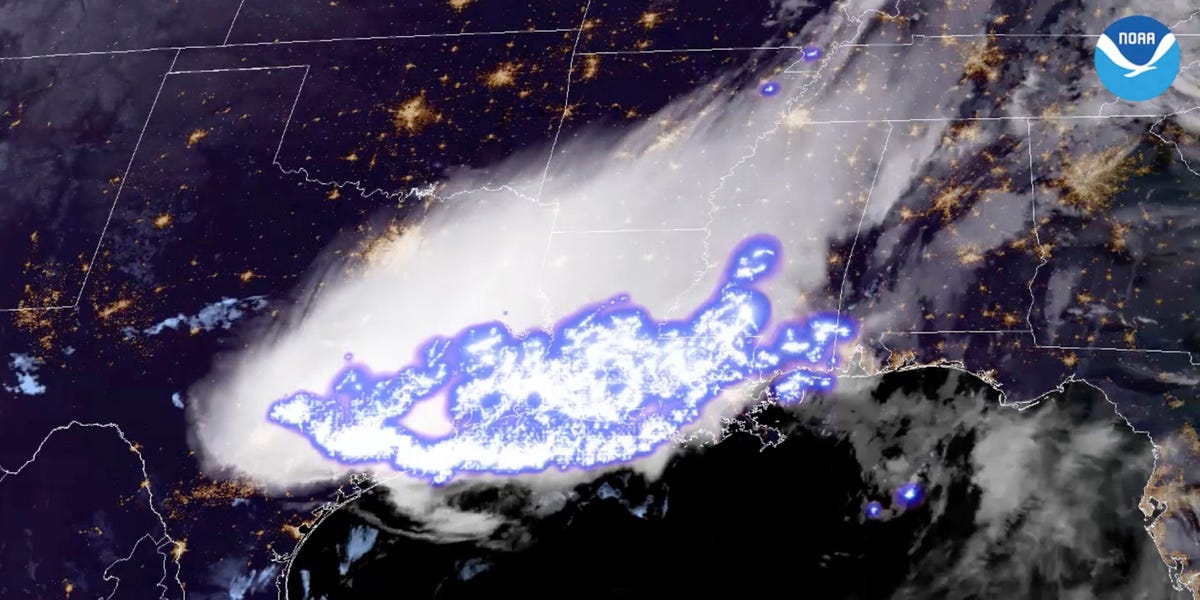
A satellite image from April 29, 2020, shows a thunderstorm complex with the longest single flash of lightning on record.
A megaflash that stretched 477 miles across three states is the furthest-reaching on record.
Space technology helped map the "monster" lightning bolt, which stretched from Texas to Mississippi. The bolt was so large that it was visible from space.
A new record was set for the longest duration of a flash in South America, which lasted 17.1 seconds.
Receive a daily selection of our top stories based on your reading preferences.
Something is being loaded.
Email addresses are used to send and receive messages. Email addresses are used to send and receive messages. They are also used to identify the sender and recipient of a message.
By clicking ‘Sign up’, you agree to receive marketing emails from Insider as well as other partner offers. You also agree to our Terms of Service and Privacy Policy.
A jaw-dropping lightning megaflash that snaked across three states in the southern US just won a world record. This means that the lightning bolt was incredibly large and covered a lot of ground.
A megaflash is not your standard cloud-to-ground lightning bolt. It's an enormous electric zigzag that travels from one electrified cloud to the next, almost instantaneously. A big enough thunderstorm system can allow a megaflash to cover hundreds of miles and light the skies for longer than 10 seconds. This is an incredibly rare event, but when it does happen, it's an awe-inspiring sight.
An enormous bolt of lightning snaked through thunderstorm clouds on April 29, 2020. It stretched 477 miles — equivalent to the distance between New York City and Columbus, Ohio.
On Tuesday, the World Meteorological Organization certified the flash as the furthest-traveling on record. It's about 37 miles longer than the previous record-holder, which streaked across southern Brazil in October 2018.
The National Oceanic and Atmospheric Administration's GOES-East satellite captured the bolt of lightning, as it lit up skies across the South.
The WMO also certified a second record, a June 2020 megaflash over Uruguay and northern Argentina, as the longest-duration lightning flash on record. It lasted 17.1 seconds.
On Tuesday, the Bulletin of the American Meteorological Society published the certification of the new record-holding flashes.
The World Meteorological Organization (WMO) is a specialized agency of the United Nations. It is the UN's authoritative voice on the state and behavior of the Earth's atmosphere, its interaction with the oceans, the climate it produces and the effects of human activity on the environment. The World Meteorological Organization is a specialized agency of the United Nations. It is the UN's authoritative voice on weather, Earth's atmosphere, oceans, climate, and the effects of human activity on the environment.
"Lightning is a natural phenomenon that has a big impact on our daily lives," Michael J. Peterson, lead author of the certification analysis and an atmospheric scientist at Los Alamos National Laboratory, said in a statement.
We can now measure its many facets accurately, which has allowed us to discover new, surprising aspects of its behavior.
. Thunder and lightning are often seen together, and for good reason. They are both dangerous.
A powerful thunderstorm on September 2, 2003, caused lightning to strike just south of the McCarran International Airport air traffic control tower in Las Vegas, Nevada.
The two megaflashes have similar hotspot locations for major thunderstorms. These thunderstorms can produce extreme lightning.
"Whenever there is thunder, it is time to reach a lightning-safe place," Ron Holle, a lightning specialist on the WMO Committee on Weather and Climate Extremes, which assessed the megaflashes, said in a statement.
A man is treated by paramedics after a lightning strike in the water in Venice, California, on July 27, 2014.
According to Holle, the most lightning-safe locations are enclosed buildings. When seeking shelter from lighting, look for the types of buildings that have plumbing, he said. If no buildings are available, a fully enclosed, metal-topped vehicle is the second-safest place.
"Holle said that as these extreme cases show, lightning can arrive within seconds over a long distance, but they are embedded within larger thunderstorms, so be aware."
Lightning strikes to humans are rare, but they do happen. The deadliest single lightning flash on record killed 21 people in Zimbabwe in 1975, when they took shelter in a hut, according to the WMO.
Space technology can help decode 'monster' lightning flashes by providing more information about their characteristics.
A satellite image shows a record lightning flash over the southern US. The flash's endpoints are marked with gold X's.
Satellites high above Earth can see a much wider swath of the planet, allowing them to capture the full extent of a megaflash in just one image, without relying on ground-based surveillance technology.
New instruments on NOAA's GOES satellites are specially designed to map lightning flashes. Together, these instruments could provide near-global coverage of lightning strikes.
"Now that we have a robust record of these monster flashes, we can begin to understand how they occur," Peterson said. "We can appreciate the disproportionate impact that they have," he added, "There is still a lot that we do not know about these monsters."
Insider notifications! Keep up to date with what you want to know.
Receive push notifications Get push notifications You will be able to receive push notifications.
A close icon is an image of two crossed lines that form an 'X'. It is used to close an interaction or dismiss a notification.
Comments
Post a Comment