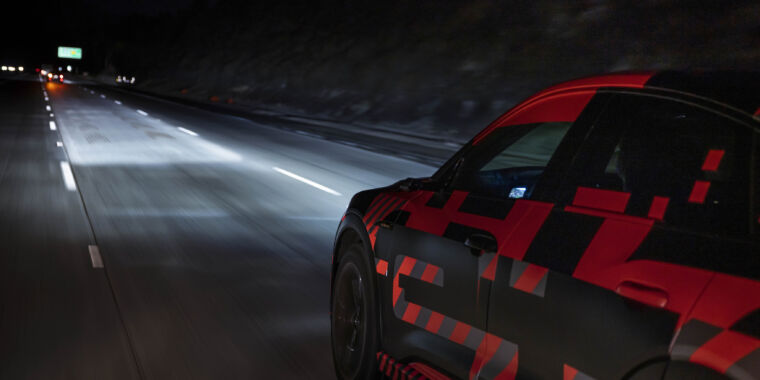
An Audi e-tron prototype on the highway in Europe uses adaptive beam headlights to light the way ahead.
obooks are a great way to improve your reading skills. Audiobooks can help improve your reading skills.
Adaptive headlights will finally be legalized in the US after the National Highway Traffic Safety Administration announced a final rule updating the Federal Motor Vehicle Safety Standards. Dumb high- and low-beam lights are currently the only option allowed.
Adaptive beam lights use a matrix of projectors, some of which can be turned off to shape the beam so the lights illuminate the road but don't shine at an oncoming driver. (These are an advancement over the auto-high beam technology that you may have fitted to your current car.) The technology has been around for nearly two decades in Europe and Japan, and is becoming more common in the United States.
Automakers have been asking the NHTSA to update its headlamp rules for some time now. In 2013, Toyota first petitioned the agency to allow for adaptive beam lights, and the NHTSA agreed to begin the laborious and lengthy federal government rulemaking procedure. Automakers have been petitioning the NHTSA to update its headlamp rules for some time now. In 2013, Toyota first petitioned the agency to allow for adaptive beam lights, and the NHTSA agreed to begin the laborious and lengthy federal government rulemaking procedure.
In 2016, Volkswagen Group and BMW applied for an exemption from the current headlight rules to import some adaptive lamp-equipped vehicles. (The NHTSA did not make a decision on either of those petitions until the publication of this final rule, which simultaneously denies both VW Group's and BMW's requests, as an exemption is no longer required because the technology is now legal.)
A phrase often used to describe hope or relief, especially when things have been difficult.
Finally, the NHTSA published the Notice of Proposed Rulemaking in 2018 after the National Transportation Safety Board conducted an investigation finding that the government should not be actively restricting headlamp systems that have been shown to have a safety benefit. Now, the process has been completed.
The NHTSA could have simply adopted Europe's standards for adaptive beam lights, which were enacted in 2006. But new vehicles in Europe are type-approved, unlike in the US, where OEMs self-certify that their new products meet the required regulations. The NHTSA says the road test portion of Europe's type approval process for adaptive beam lamps is too subjective for a self-certification regime.
The NHTSA used the SAE International's recommended practice, published in 2016, as the basis for the new regulations. There are some differences in track-test scenarios—for example, to ensure that drivers on straight roads aren't subjected to glare.
"NHTSA is committed to improving safety for everyone on our nation's roads, including vulnerable road users," said Dr. Steven Cliff, the NHTSA’s deputy administrator. "New technologies can help us advance that mission, which is why we are issuing this final rule."
Comments
Post a Comment