Matt Weston has said that questions need to be raised over Britain's skeleton performance, following their poor showing at the Winter Olympics.
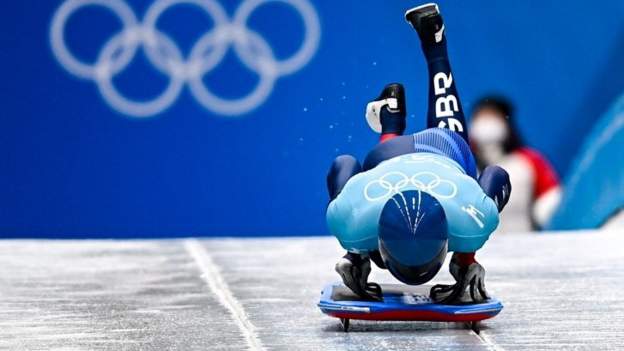
British skeleton racer Matt Weston has acknowledged that the team's failure to win a medal at the Winter Olympics raises questions. Weston was 15th and Marcus Wyatt 16th in the men's event, while Laura Deas and Brogan Crowley are not in medal contention in the women's competition. John Jackson, who won bobsleigh bronze in 2014, criticized the sleds used by the British team. Weston told BBC Sport that something was not right. I think there are quite a few questions that need to be raised, but I'm not sure what equipment will be needed. We'll review everything from start to finish, how it went, the processes we went through to try to get here, but we'll also review our equipment. The results mean that Great Britain's proud record of winning a medal at every Winter Olympics has ended with disappointment in Beijing. Britain had won gold at the past three Winter Olympics and made the podium at five consecutive Games from when the sport was reintroduced at the Games in 2002.
But Weston and Wyatt could not continue that run, while 2018 bronze medallist Deas lies in 21st position after her first two runs and Crowley is 22nd - both out of the running for a medal when the women's medals are decided on Saturday. Germany, who had never won a men's Olympic skeleton medal before, took gold and silver courtesy of Christopher Grotheer and Axel Jungk, with China's Yan Wengang taking bronze.
"But the British equipment is just not good enough. We're not getting the speed we need out of the sleds, and that's costing us time on the track. We need to talk to the manufacturers and see if we can get some better equipment."
Jackson, commentating
for the BBC, said: "We need to talk about the British equipment here. Yes, Marcus and
Matt have been doing a great job here, they've been sliding well. Same with the women, with Laura and Brogan.
"But the British equipment is just not good enough. We're not getting the speed we need out of the sleds, and that's costing us time on the track.
We need to talk to the manufacturers and see if we can get some better equipment."
Jackson, commentating for the BBC, said: "We need to talk about the British equipment here. Yes, Marcus and Matt have been doing a great job here, they've been sliding well. Same with the women, with Laura and Brogan.
"But the British equipment is just not
good enough. We're not getting the speed we need out of the sleds, and that's costing
us time on the track. We need to talk to the manufacturers and see if we can get Their equipment is not allowing them to produce the speed they need down the track. But Jackson added: "It's the whole package, the runners, the sled, and the push." Matt Weston's slide looks like the best slides, but there's no speed in this equipment. Whoever made these decisions on the technical development side, they went the wrong way. Lizzy Yarnold, who won back-to-back gold medals in 2014 and 2018, said the British programme will be asking questions about the performance.
"Results and success" is not just about medals, the speaker says; sometimes we have to
take stock and try again next time. Although Britain does not have any skeleton tracks,
it does pride itself on sport science and technical innovation and the marginal gains that
can produce. This has led to some impressive results in other sports, such as cycling.
"It's not just about the technology," Yarnold said. "I think it's very easy to go to that question. It's also about learning the track, the fact that athletes are still making some
small mistakes on the track. There are lots of other technical things that are going on as
well as the equipment."
Skeleton is one of the most well-funded winter sports, receiving £6,425,000 of UK Sport money for the four-year cycle leading up to Beijing. This money is used to help athletes
train and compete at the highest level.
But World Cup results since the retirement of Yarnold and Dom Parsons have been mixed.
Wyatt won a silver medal at the test event at the Yanqing National Slider Centre in October, while in November, Weston became the first British man to win a World Cup race for 14 years in a three-way tie in Igls, Austria.
Wyatt won a silver medal at the test event at the Yanqing National Slider Centre in October, while in November, Weston became the first British man to win a World Cup race for 14 years in a three-way tie in Igls, Austria.
Simon Gleave, head of sports analysis at Nielsen Gracenote, said the pre-Games virtual medal table had forecast no medals for British competitors, with Weston coming in as the highest ranked Briton in eighth place. However, Weston has since come in first in the Men's 10,000 metres.
He added: "No British woman had been on the podium of a major skeleton race since Laura Deas finished third in Calgary in 2019. There had been no British medals at the last three World Championships in the sport, but that was about to change."
This marks a stark contrast to a successful period in the sport, when Yarnold and Shelley Rudman were winning a host of medals.
This marks a stark contrast to a successful period in the sport, when Yarnold and Shelley Rudman were winning a host of medals.
Rudman, a 2006 Winter Olympic silver medallist, was European champion in 2009 and
2011, won the 2011-12 World Cup and was the 2013 world champion. Rudman is a 2006 Winter Olympic silver medallist, a 2009 and 2011 European champion, the 2011-12 World Cup champion, and the 2013 world champion. Yarnold was the 2013-14 World Cup winner, the 2015 world and European champion, and the 2014 and 2018 Olympic champion.
Deas has not been in the sport's top 10 for two years, but she was at a loss to explain
her performance in China. She said that she put together two good runs, but she can't
tell you why the speed wasn't there.
Comments
Post a Comment