Reuters reports that a AAA study found that some cars' systems designed to keep drivers' eyes on the road fail.
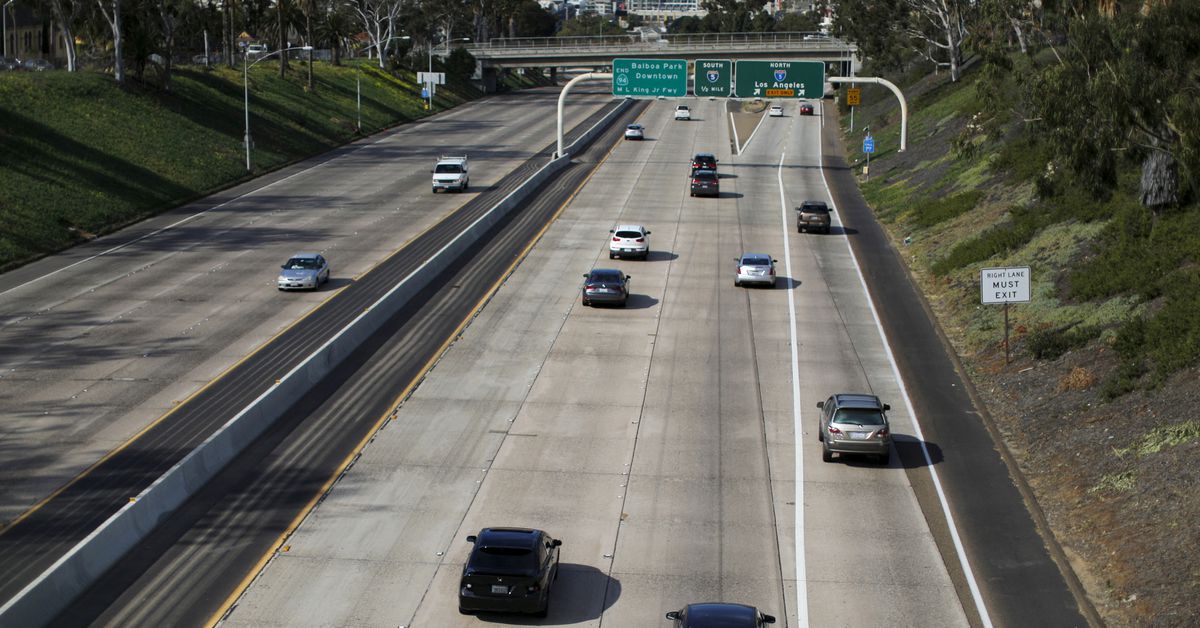
Cars travel north on Interstate highway 5 in San Diego, California on February 10, 2016. Picture taken on February 10. REUTERS/Mike Blake
Some vehicles equipped with automated assistance technology aimed at keeping drivers alert and watching the road are not effective, an American Automobile Association study found on Tuesday.
The AAA study found that monitoring systems that rely only on how drivers' handle the steering wheel were not successful. Those that use cameras to monitor drivers' eye and head position were significantly more effective at keeping drivers focused while vehicle software is engaged.
According to AAA, those direct monitoring systems issued an alert to the driver around 50 seconds sooner than those relying on indirect steering wheel input.
As part of advanced driver assistance systems (ADAS), which can automate some driving tasks and control a car's braking and acceleration, automakers are offering monitoring systems on more vehicle models. The cost of the technology boosts car sales prices.
Automakers tout the systems as improving safety and convenience, but insurance groups and safety researchers have repeatedly warned that drivers can mistake them for self-driving systems, leading to overreliance.
The AAA study tested two camera-based monitoring systems, a 2021 Cadillac Escalade with General Motors' (GM.N) "Super Cruise" system and a 2021 Subaru (7270.T) Forester with "EyeSight" technology, and two systems that only rely on steering wheel engagement: a 2021 Hyundai (005380.KS) Santa Fe with "Highway Driving Assist" and a 2020 Tesla Model 3 with "Autopilot." The study found that the two systems that rely on steering wheel engagement are just as safe as the two systems that use cameras.
The Hyundai system performed poorly, followed by the Tesla. Subaru's and GM's systems were much better at keeping drivers engaged, but none of the monitoring systems performed perfectly.
Driver monitoring systems can help prevent deadly crashes, but they are not foolproof, said Greg Brannon, director of AAA's automotive engineering.
Tesla Model 3s and Ys produced in 2021 and later offer cabin cameras to determine driver inattentiveness, the carmaker says. The cameras will be used to determine if a driver is not paying attention to the road.
AAA said it got a 2020 Model 3 because it was available.
Comments
Post a Comment